A few years ago, it seemed like new AI platforms were popping up all over. And like many AI-curious companies, we didn't have a strategy on which one to choose and use — we had subscriptions.
At one point we found ourselves running on four platforms at once — Perplexity, ChatGPT, Gemini, and Claude — with our team choosing their weapon-of-choice based largely on vibes. No formal evaluation framework, no scoring rubric, and no objective finish line.
One of those platforms came with an expiry date — a blessing in disguise, in retrospect. Thanks to having a Perplexity Fellow on our staff, we had a free enterprise Perplexity account for 12 months. And we used that 12 months as a deadline to decide who would be paying, long term.
We landed on Claude. And we're not writing this to tell you that you should too.
We're writing it because the process of getting there illustrates some of the thinking and critical evaluation that many companies are struggling with in making their own selection. AI models are in an arms race, with updates and improvements being announced in rapid succession. And choosing between them as they continually leapfrog for pole position has led a lot of leaders to analysis-paralysis.
But if you're a business owner or marketing leader trying to figure out which platform is right for your organization, the lessons from our one-year detour might save you the trip.
Start with two, three, four… but definitely not one
Most organizations approach the AI platform selection decision backwards. They pick the platform they've heard the most about — usually ChatGPT, because it was first — and then try to make it work. They never really evaluate. They just adopt.
We stumbled into a better approach by accident. Because we had parallel subscriptions running, our team was naturally experimenting across platforms at the same time. Conversations over MS Teams* and in hallways started surfacing patterns. Some tools felt better for research. Others were more useful for drafting. But one in particular kept coming up when people were doing actual work.
* You might be curious why an organization using the Microsoft suite didn’t include Copilot among our potential AI platform selections. Let’s just say… we have our reasons.
That kind of organic signal is hard to manufacture, but easy to create the conditions for. The lesson isn't "run four subscriptions forever." Rather, before you commit, give a few platforms genuine exposure with your actual work, not demo prompts. The differences only show up when you're doing real things.
And give yourself a deadline. As we said, ours was built in. If you don't have a natural one, set one. Without a forcing function, the evaluation never ends.
The model isn't the product
Here's the thing most AI coverage gets wrong: it treats the underlying model (the proverbial brain powering the AI platform) as the primary variable. Understandably so: we all want ‘the best’ version of whatever we’re buying.
So benchmarks get compared. New releases get ranked. Then, benchmarks change.
There’s a running internet joke about this — whoever shipped last has “the best model”. ChatGPT drops something: best model. Claude drops something: best model. Gemini drops something: best model. It's a never-ending merry-go-round.
And chasing it is a losing game.
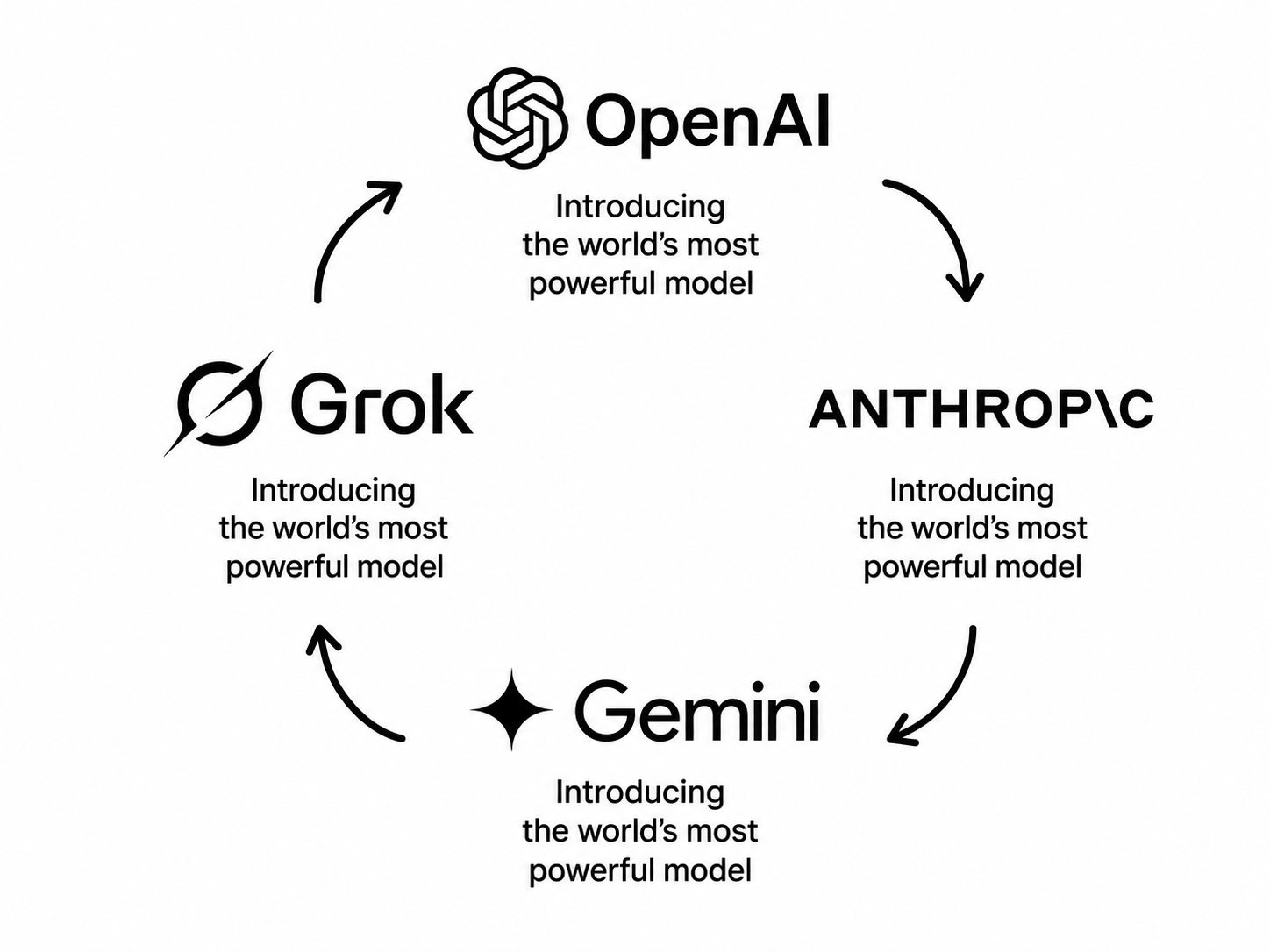
Here we go again (Credit: Unknown Reddit user)
For us, the model mattered less than the product. The product describes the capabilities and functions that each model is powering — the stuff you actually work with.
At the time we made our decision, Gemini's models were arguably competitive with — maybe even marginally better than — Claude's. But its ecosystem of products and capabilities didn’t fit our kind of work (we’ll talk about this shortly). So even though the underlying model was the same (or better), the product wasn’t right for what we do. Which greatly helped simplify our decision-making process.
The platform decision is a product decision. Evaluate it like one.
Does it fit how you actually work?
Choosing the right platform/product really boils down to the type of work your organization does, and how you work as a team.
For us, the selection came down to a few specifics: the ability to create shared projects, use skills (reusable instruction sets that can be shared across a team), and a clear orientation toward knowledge work — writing, thinking, researching, drafting — as opposed to either a highly-specialized or general-purpose consumer AI.
Your answer may be different. If your organization runs entirely on Google Workspace, Gemini might slot in perfectly. If you run on Microsoft 365… we’d recommend you evaluate a systems-agnostic AI platform before defaulting to Copilot. Convenience, in other words, is a factor, but shouldn’t be the deciding one.
Ask the practical questions early: How does this work across a team, not just individually? Can we share context, prompts, or workflows — essentially, is this a productivity and efficiency multiplier? Where does it plug into the tools we already use? Does the subscription model make sense for our size?
A tool your team uses is worth more than a tool they don't. Adoption drives fluency. Fluency drives consistency. And consistency drives the productivity gains you're actually after.
Don't chase the high
Once you've made a decision and built workflows around a platform, switching to chase the latest release and ‘best’ model has real costs — and most of them aren't technical.
Yes, there's the setup: migrating projects, rebuilding shared resources, learning a new interface.
But the bigger cost is adoption. Every time a team starts over with a new tool, you reset the learning curve. The fluency your people built — the instincts about how to prompt, what to use the tool for, where it's weak — that gets wiped. Despite the chat interfaces being similar between AI platforms, from a functionality perspective you're asking people to start from zero again.
That shapes our decision to make an informed, tested decision — and stay put. A minor model improvement from a competitor isn't a reason to move. Even a meaningful one might not be, if the rest of the product doesn't justify the disruption. The gap has to be large enough to outweigh the reset.
That said: someone should be watching. Keeping a hand in other platforms — even lightly — means you're not flying blind. You're just not chasing every benchmark update like it's a fire alarm.
Your AI stack will be plural (and that's fine)
Claude is our hub. It handles the bulk of knowledge work across our team — writing, research, client prep, strategy, briefing. But it's not the only tool we use.
We have a separate subscription for image and video generation. Adobe's AI features are part of our design workflow. These aren't redundancies — they're specializations. General-purpose AI assistants are built to do everything adequately. Specialized tools are built to do specific things well.
Decide what your "hub" is — the platform your team defaults to for general knowledge work — and let everything else orbit around it. Don't try to run your whole operation through one tool because it feels tidier.
And don't avoid choosing a hub because the category is still evolving. The category is always going to be evolving. That's not a reason to wait.
We had a year to get it right — you don’t
The competitive pressure to get moving on AI isn't theoretical anymore. Business leaders who've been watching from the sidelines are now feeling it directly — in the time their teams spend on tasks that could be faster, in the gap between what they're producing and what's possible.
What we went through over 12 months — the parallel testing, the organic evaluation, the platform comparisons, the eventual decision — that's something we can now shortcut for you. Not by telling you which platform to use. But by helping you figure out which one fits your organization, your workflows, and your team.
That's exactly what our AI Unlocked workshop is designed to do. It starts with a free session (up to two hours) that gives you directional clarity on your AI implementation — where to begin, what platform makes sense for you, and what a realistic first step looks like. No sales pitch. No one-size-fits-all recommendation. Just a focused conversation that gets you pointed in the right direction.
If you've been waiting for the right moment to figure this out — AI Unlocked is a low-risk way to start. Schedule your free 2-hour session, today.